Entrepreneurship 101: Your Complete Guide to Starting a Business
 By
By Entrepreneurship 101: Your Complete Guide to Starting a Business
Starting your own business can feel like standing at the edge of a cliff, wondering if you should take the leap. The entrepreneurial journey is equal parts thrilling and terrifying, but with the right knowledge and preparation, you can turn your business dreams into reality. Whether you’re a recent graduate with a revolutionary app idea or a seasoned professional ready to break free from the corporate world, this comprehensive guide will walk you through everything you need to know about starting a business from scratch.
Table of Contents
1. Understanding Entrepreneurship: What It Really Means
2. Finding Your Business Idea: From Passion to Profit
3. Market Research: Validating Your Business Concept
4. Creating a Solid Business Plan
5. Legal Structure and Business Registration
6. Securing Funding for Your Startup
7. Building Your Brand and Online Presence
8. Managing Finances and Cash Flow
9. Common Mistakes to Avoid
10. Taking the First Steps

Understanding Entrepreneurship: What It Really Means
Entrepreneurship isn’t just about having a great idea or wanting to be your own boss. It’s about identifying problems in the market and creating innovative solutions that add value to people’s lives. At its core, entrepreneurship requires a unique blend of creativity, risk-taking, and business acumen.
The modern entrepreneur wears many hats. One day you might be developing your product, the next you could be pitching to investors or handling customer service complaints. This versatility is both challenging and rewarding, as it allows you to have direct control over your business’s direction and growth.
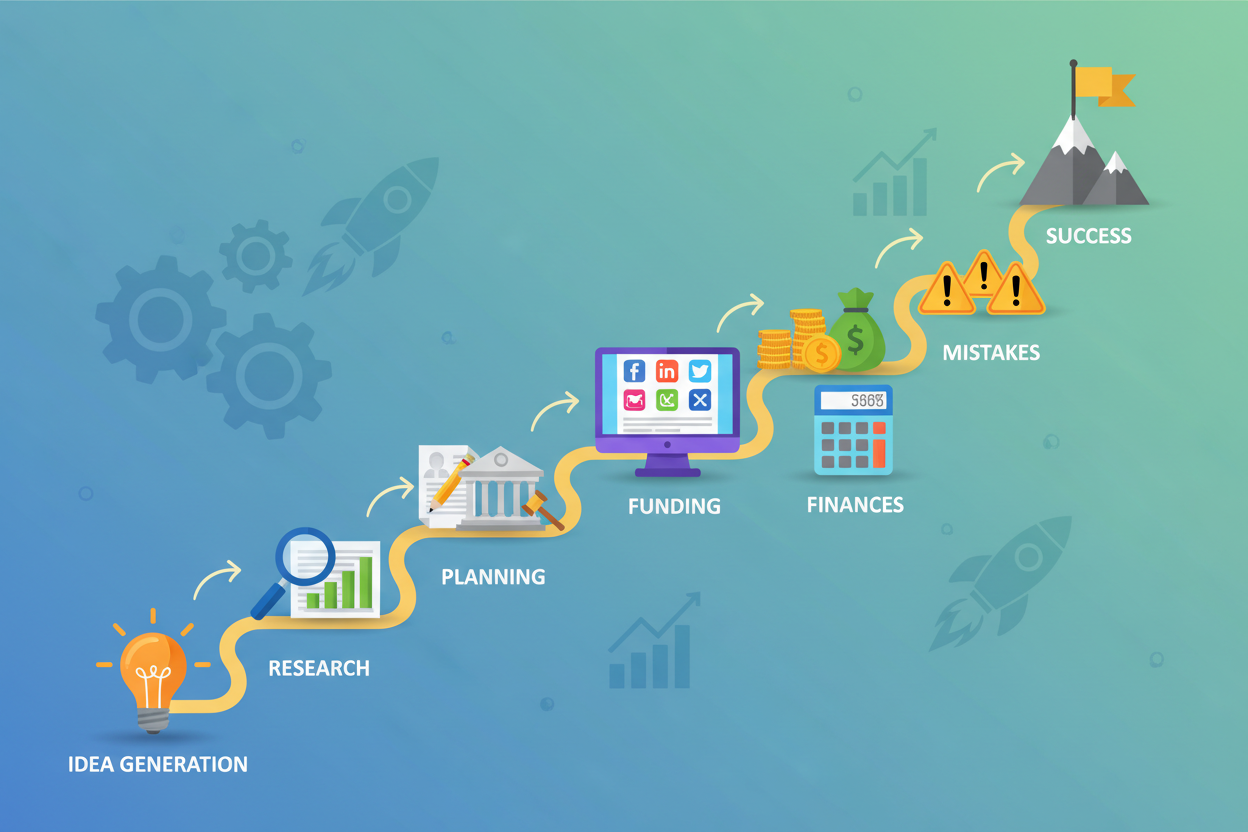
Successful entrepreneurs share certain characteristics: they’re persistent when facing obstacles, adaptable when market conditions change, and passionate about their vision. They understand that failure isn’t the opposite of success but rather a stepping stone toward it.
Finding Your Business Idea: From Passion to Profit
The best business ideas often come from personal experiences or frustrations. Think about problems you encounter daily or industries where you see gaps in service or quality. Your business idea doesn’t need to be completely revolutionary; sometimes, executing an existing concept better than competitors is enough.
Start by examining your skills, interests, and expertise. What are you naturally good at? What do friends and family come to you for help with? These personal strengths can form the foundation of a profitable business venture.
Consider trending industries like sustainable products, health and wellness, remote work solutions, or digital services. However, don’t chase trends blindly. The most sustainable businesses solve real problems for specific target audiences.
Brainstorm multiple ideas before settling on one. Write them down, research their potential, and discuss them with trusted advisors. The idea that excites you most and has the strongest market potential deserves your full attention.
Market Research: Validating Your Business Concept
Having a great idea is just the beginning. Market research helps you understand whether people actually want what you’re offering and if they’re willing to pay for it. This step can save you thousands of dollars and months of wasted effort.
Start with online research using tools like Google Trends, industry reports, and competitor analysis. Look at similar businesses in your area or niche. What are they doing well? Where are they falling short? This competitive intelligence will help you position your business effectively.
Don’t rely solely on online research. Talk to potential customers directly through surveys, interviews, or focus groups. Ask about their current solutions, pain points, and what they’d want from an ideal product or service. Their feedback might reshape your entire approach.
Test your concept with a minimum viable product (MVP) or pilot program. This could be as simple as offering your service to a few customers at a discounted rate in exchange for honest feedback. Real-world testing provides invaluable insights that theoretical research cannot.
Creating a Solid Business Plan
A business plan serves as your roadmap to success. It forces you to think through every aspect of your business and helps secure funding from investors or lenders. While it doesn’t need to be a 50-page document, it should cover all essential elements clearly and concisely.
Your executive summary should capture your business concept, target market, competitive advantages, and financial projections in just a few paragraphs. This section is often the only part investors read initially, so make it compelling.
Include detailed sections on your products or services, target market analysis, marketing and sales strategies, operational plans, and financial projections. Be realistic with your numbers and assumptions. Overly optimistic projections can damage your credibility.
Your business plan isn’t set in stone. Successful entrepreneurs regularly update their plans as they learn more about their market and refine their strategies. Think of it as a living document that evolves with your business.
Legal Structure and Business Registration
Choosing the right legal structure affects your taxes, liability, and ability to raise capital. The most common options for new businesses are sole proprietorship, partnership, LLC, and corporation. Each has distinct advantages and disadvantages.
Sole proprietorships are simple and inexpensive to establish but offer no liability protection. LLCs provide liability protection while maintaining operational flexibility and tax benefits. Corporations offer the strongest liability protection and easier access to investment capital but involve more complex regulations and tax requirements.
Register your business name and obtain necessary licenses and permits. Requirements vary by location and industry, so research your local and state regulations thoroughly. Some businesses need special permits, professional licenses, or health department approvals.
Consider consulting with an attorney or accountant during this process. While it involves upfront costs, professional guidance can prevent expensive mistakes and ensure you’re properly protected from the start.
Securing Funding for Your Startup
Most new businesses require some initial capital for equipment, inventory, marketing, and operating expenses until revenue becomes consistent. Understanding your funding options helps you choose the best approach for your situation.
Bootstrap funding using personal savings, credit cards, or loans from friends and family. This approach maintains complete control over your business but limits your available capital and increases personal financial risk.
Traditional bank loans offer larger amounts at reasonable interest rates but require strong credit scores, collateral, and detailed business plans. Many banks are hesitant to lend to brand-new businesses without established revenue streams.
Alternative funding sources include angel investors, venture capital, crowdfunding platforms, and government grants or programs for small businesses. Each option has different requirements, timelines, and implications for your business ownership and control.
Calculate exactly how much funding you need by creating detailed financial projections for at least the first year. Include one-time startup costs and ongoing operating expenses, plus a buffer for unexpected challenges.
Building Your Brand and Online Presence
Your brand is more than just a logo or business name; it’s the complete experience customers have with your business. Strong branding differentiates you from competitors and builds customer loyalty over time.
Develop a clear brand identity that reflects your values, personality, and target audience. This includes your visual elements like logos and color schemes, as well as your tone of voice and messaging strategy. Consistency across all touchpoints reinforces your brand and builds recognition.
Establish your online presence with a professional website that clearly communicates what you offer and how customers can work with you. Even service-based businesses need websites for credibility and discoverability. Ensure your site is mobile-friendly and optimized for search engines.
Social media platforms provide cost-effective ways to reach and engage with your target audience. Choose platforms where your customers spend time rather than trying to maintain a presence everywhere. Quality content and genuine engagement matter more than follower counts.
Managing Finances and Cash Flow
Financial management can make or break your business, regardless of how great your product or service is. Many profitable businesses fail due to poor cash flow management, so understanding your finances is crucial from day one.
Set up proper accounting systems to track income, expenses, and cash flow. Cloud-based accounting software makes this easier for small businesses, providing real-time financial insights and simplifying tax preparation. Keep business and personal finances completely separate.
Create realistic budgets and regularly compare actual results to your projections. This helps identify trends, control costs, and make informed decisions about investments or expense cuts. Understanding your break-even point helps set realistic sales goals.
Establish relationships with reliable suppliers and understand their payment terms. Negotiate favorable terms when possible, but always honor your agreements to maintain good relationships. Late payments can damage your reputation and limit future opportunities.
Common Mistakes to Avoid
Learning from others’ mistakes can save you significant time, money, and stress. Many new entrepreneurs make similar errors that are entirely preventable with proper planning and awareness.
Don’t skip market research or ignore customer feedback. Assuming you know what customers want without validation leads to products or services that nobody buys. Stay connected to your market and be willing to pivot when necessary.
Avoid perfectionism that prevents you from launching. Your first version doesn’t need to be perfect; it needs to be good enough to test with real customers. You can improve and refine based on actual feedback rather than theoretical concerns.
Don’t neglect legal and financial fundamentals. Proper contracts, insurance, and accounting systems protect your business and enable growth. Cutting corners in these areas often costs more in the long run than doing things right initially.
Resist the urge to do everything yourself. While bootstrapping requires wearing many hats, recognize when to delegate or outsource tasks that others can do better or more efficiently. Your time is valuable and should focus on activities that directly drive business growth.
Taking the First Steps
Starting a business feels overwhelming when you consider everything that needs to be done. Break it down into manageable steps and focus on making consistent progress rather than trying to do everything at once.
Begin with thorough planning and research before investing significant money. Validate your idea, understand your market, and create a basic business plan. These foundational steps reduce risk and increase your chances of success.
Set realistic timelines and milestones for key activities like business registration, website launch, or first customer acquisition. Celebrate small wins along the way to maintain motivation during challenging periods.
Build a support network of fellow entrepreneurs, mentors, and advisors. Join local business groups, attend networking events, or participate in online communities. Learning from others’ experiences and having people to turn to for advice makes the journey less isolating and more successful.
Remember that entrepreneurship is a marathon, not a sprint. Focus on building sustainable systems and relationships rather than seeking overnight success. Persistence and continuous learning are often more important than initial brilliance.
Conclusion
Starting a business is one of the most challenging yet rewarding endeavors you can undertake. It requires careful planning, hard work, and the courage to take calculated risks. While there are no guarantees of success, following proven principles and learning from experienced entrepreneurs significantly improves your odds.
The entrepreneurial journey will test your resolve, creativity, and adaptability. You’ll face setbacks and obstacles that seem insurmountable, but each challenge presents an opportunity to learn and grow stronger. The skills and resilience you develop while building your business will serve you well throughout your career.
Take time to properly plan and prepare, but don’t let perfectionism prevent you from starting. The best time to plant a tree was 20 years ago; the second-best time is now. Your business idea won’t become reality until you take action, so start with one small step today.
Frequently Asked Questions
How much money do I need to start a business?
Startup costs vary dramatically depending on your business type. Service businesses might start with just a few hundred dollars, while manufacturing or retail businesses could require tens of thousands. Create a detailed budget including equipment, inventory, marketing, legal fees, and at least 3-6 months of operating expenses.
Do I need a business plan if I’m starting small?
Yes, even small businesses benefit from planning. Your business plan doesn’t need to be lengthy, but it should outline your goals, target market, competition, and financial projections. This exercise helps clarify your thinking and identifies potential challenges before they become problems.
When should I quit my day job to focus on my business?
Consider leaving your job when your business generates consistent income that covers your personal expenses, or when you have enough savings to support yourself during the transition. Many successful entrepreneurs start their businesses as side projects while maintaining steady income from employment.
How do I know if my business idea is good?
A good business idea solves a real problem for a specific group of people who are willing to pay for the solution. Validate your idea through market research, customer interviews, and testing with a minimum viable product. If people consistently express interest and willingness to pay, you likely have a viable concept.
What’s the biggest mistake new entrepreneurs make?
The most common mistake is assuming they know what customers want without proper validation. Many entrepreneurs fall in love with their idea and skip market research, leading to products or services that don’t meet actual market needs. Always prioritize customer feedback over personal assumptions.
The Ultimate Dubai Wealth Blueprint: Tax-Free Income, Real Estate & Passive Systems
Looking to build lasting wealth in Dubai? This complete guide reveals proven strategies for expats and entrepreneurs, including tax-free income systems, real estate investment secrets, passive income streams, business setup tips, and wealth preservation tactics. Learn how expats successfully grow and protect their money in the UAE with zero income tax and unlimited potential. No fluff. Just actionable Dubai wealth building methods that work.
Dubai Wealth Secrets: Tax-Free Strategies for Entrepreneurs